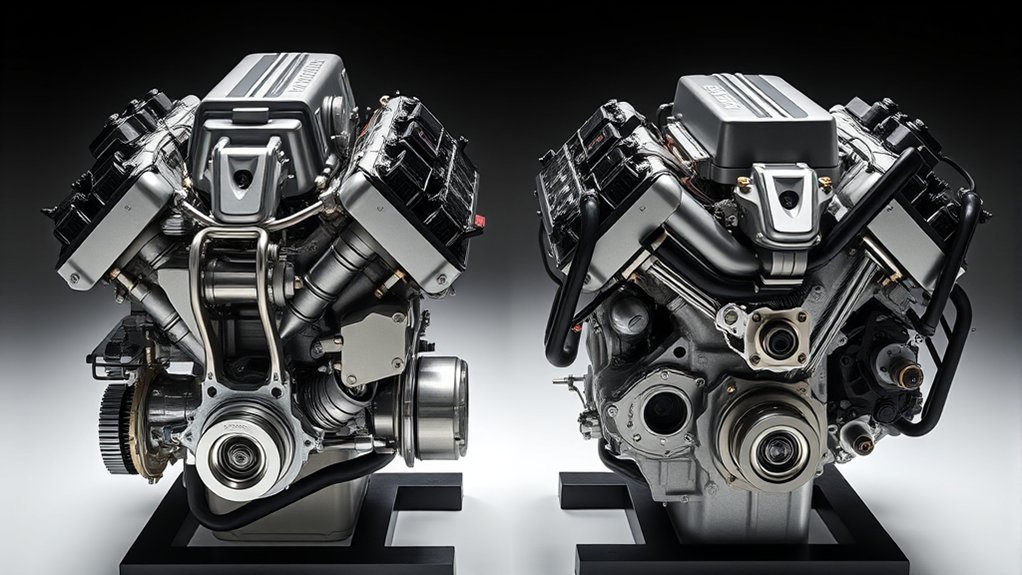
The Toyota GR Supra (A90, 2020 and later) came with two engines in the US: a 3.0-liter turbocharged inline-six with 382 hp and 368 lb-ft, and, from 2021 to 2024, a 2.0-liter turbocharged inline-four with 255 hp and 295 lb-ft. The six is faster, heavier and the only engine left for 2025 and newer. The four was lighter, cheaper and slightly more fuel efficient.
Which Supra Has Which Engine
This comparison applies to the fifth-generation GR Supra. Earlier Supras (A80 and before) used inline-six engines only, so the inline-four exists only in the current car. Both GR Supra engines are BMW-sourced turbocharged units, and the 2.0-liter came from the same family as the engine in the BMW Z4 sDrive30i.
- 2020: 3.0 only, rated at 335 hp.
- 2021-2022: 3.0 (power raised to 382 hp) and the new 2.0, both with an eight-speed automatic.
- 2023-2024: 2.0 automatic, plus a 3.0 that could be ordered with a six-speed manual or the automatic.
- 2025 onward: the 2.0 was dropped. Only the 3.0 and 3.0 Premium remain, with manual or automatic.
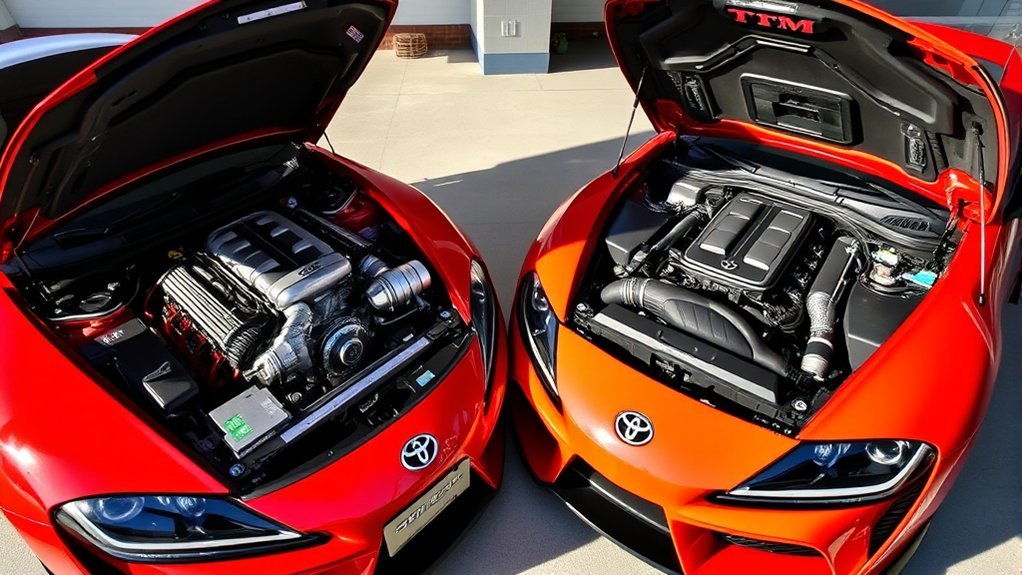
Specs Side by Side
The figures below are Toyota’s 2021 launch numbers. Check the spec sheet for your model year, because later years can differ slightly.
| Spec | Supra 2.0 (inline-four) | Supra 3.0 (inline-six) |
|---|---|---|
| Power | 255 hp at 5,000-6,500 rpm | 382 hp at 5,800-6,500 rpm |
| Torque | 295 lb-ft at 1,550-4,400 rpm | 368 lb-ft at 1,800-5,000 rpm |
| 0-60 mph (Toyota claim) | 5.0 seconds | 3.9 seconds |
| Curb weight (2021) | 3,181 lb | 3,400 lb |
| Front brakes | 330 mm rotors, single-piston calipers | 348 mm rotors, four-piston calipers |
| Wheels | 18-inch cast aluminum | 19-inch forged aluminum |
| Active differential | No | Yes |
| Adaptive suspension | No | Yes |
| Transmission | 8-speed automatic | 8-speed automatic; 6-speed manual from 2023 |
The 2.0 is 219 pounds lighter, and Toyota describes the 2.0 as keeping near 50:50 weight distribution. The four-cylinder does not have a meaningfully different balance; the advantage is lower mass overall.
Performance and Driving Feel
The 3.0 has 127 more horsepower and 73 more lb-ft of torque, which is why it is about a second quicker to 60 mph. Peak torque arrives early in both engines (1,550 rpm for the four, 1,800 rpm for the six), so neither feels laggy in town. The difference shows up when you pull hard: the six keeps building speed on highway on-ramps and passes, while the four runs out of urgency sooner.
The 3.0 also gets hardware that changes how the car handles at the limit: larger four-piston brakes, an active rear differential and adaptive dampers. The 2.0 has no active differential and no adaptive suspension. Its lower weight still makes it light on its feet on tight roads, and many owners choose it for a simpler, cheaper car that is enjoyable below the limit.
Sound and smoothness
An inline-six is naturally well balanced, and it tends to run smoother and sound fuller than a four-cylinder. The inline-four has more vibration by design and a less distinctive exhaust note. This is a matter of taste, but it is the reason many buyers treat the six as the “real” Supra.
Fuel Economy
EPA ratings vary by model year and transmission, so check the exact year on the EPA site (fueleconomy.gov) before you rely on a number. As a reference point, listings based on EPA data show the 2023 Supra 2.0 at about 25 mpg city and 31 highway. The 2023 3.0 automatic was listed at 23 city and 31 highway, and the 3.0 manual at 19 city and 27 highway. The 2026 3.0 automatic is listed at 22 city, 29 highway and 25 combined.
In practice the gap between the two engines is small, a couple of mpg at most with the automatic. If fuel cost is your main concern, the manual 3.0 is the thirstiest of the group. Both engines are turbocharged and listed for premium gasoline, so fuel cost per mile is higher than on a typical commuter car either way. Confirm the required octane in your owner’s manual.
Price and Availability
- At the 2021 launch the 2.0 started at $43,985, while the 3.0 started at $51,985 and the 3.0 Premium at $55,485.
- By 2025, when the four-cylinder was dropped, the base 3.0 started at $57,345, compared with $47,535 for the last 2.0. That is the lowest price for a new Supra today.
- For a used car, the 2.0 is the cheaper way in, but it lacks the brakes, differential and adaptive suspension of the 3.0. Confirm the trim and equipment of any used car from its window sticker or VIN.
Which Engine Should You Choose
- You want a new Supra: the 3.0 is your only choice, with the option of a manual.
- You want the lowest purchase price used: look for a 2021-2024 Supra 2.0, and pay for an independent pre-purchase inspection.
- You plan track days or canyon driving: the 3.0, because of its brakes, differential and adaptive suspension.
- You want a manual gearbox: only the 3.0 (2023 and newer) offers it. The 2.0 was automatic only.
Frequently Asked Questions
Is the Supra 2.0 a real Supra?
It is a genuine GR Supra built on the same platform and sold by Toyota, but it is the only Supra with a four-cylinder. Earlier Supras all used six-cylinder engines, which is why some enthusiasts prefer the 3.0.
Is the inline-six more reliable than the inline-four?
Toyota does not publish reliability comparisons between the two, and neither engine has a proven advantage. Both are turbocharged and benefit from regular oil changes at the interval in your owner’s manual. Do not assume either engine is cheaper to maintain; ask a dealer or independent shop for service quotes on the exact model year you are considering.
Does the 2.0 handle better because it is lighter?
It is 219 pounds lighter and feels nimble, but the 3.0 adds 19-inch forged wheels, bigger brakes, adaptive dampers and an active differential. Those parts give the 3.0 more capability at the limit, which matters most on a track.
Can you still buy a new Supra with the four-cylinder?
No. The 2.0 was dropped for the 2025 model year in the US. New Supras are 3.0 and 3.0 Premium only.
Does the Supra 3.0 come with a manual?
Yes, a six-speed manual has been available with the 3.0 since the 2023 model year, and it continues on the current lineup at no extra cost.
Buying a Used Supra: What to Check
Because the two engines share a body, it is easy to confuse them in a used listing. Use these checks before you pay.
- Confirm the engine from the VIN or window sticker, not from the ad text. The 2.0 and 3.0 have different brakes, wheels and equipment, so a mismatch is easy to spot in person.
- Look at the front brakes and wheels. Four-piston calipers behind 19-inch wheels indicate a 3.0. Smaller single-piston calipers and 18-inch wheels indicate a 2.0.
- Ask for service records. Both engines are turbocharged, so regular oil changes matter. Follow the intervals in the owner’s manual.
- Check for open recalls by entering the VIN on the NHTSA recall lookup or Toyota’s owner site.
- Look for signs of track use or modification, such as aftermarket tunes, worn tires on one axle, or heavily worn brake pads and rotors.
- Verify the warranty status. Toyota’s warranty terms depend on the model year and on whether the car was sold new by a dealer, so read the warranty booklet or ask a dealer to look up the VIN.
Bottom Line
If you can afford it, buy the 3.0: it has the power, the brakes and the suspension hardware, and it is the only engine Toyota still sells. If budget matters more than outright speed, a clean 2021-2024 Supra 2.0 is a capable, lighter sports coupe, provided you accept the lower equipment level.