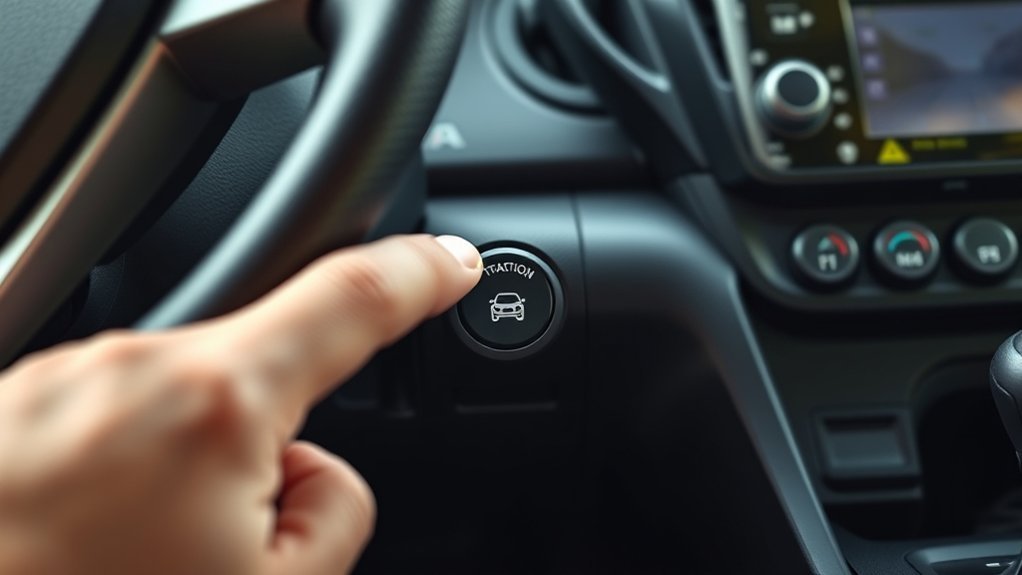
Traction control on a Toyota RAV4 is on by default every time you start the engine, so in normal driving there is nothing to switch on. If you turned it off with the VSC OFF switch, press that switch once more, or turn the engine off and restart it, and the system is active again. This guide explains what the switch does on each generation, what the dashboard lights mean, and when a light that stays on points to a fault.
How traction control works on a RAV4
Toyota calls its traction control TRAC. It works together with Vehicle Stability Control (VSC). When a drive wheel starts to spin on a wet, icy or loose surface, TRAC reduces engine power and brakes the spinning wheel so the other wheel can keep pulling. VSC does a related job in corners: if the vehicle starts to slide sideways, it brakes individual wheels and can reduce power to bring the vehicle back in line.
Both systems run on their own. You only interact with them through the VSC OFF switch on the instrument panel and through the lights in the gauge cluster.

How to turn traction control on or off, step by step
The switch has two stages. A short press affects TRAC only. A long press affects both TRAC and VSC. The wording below comes from Toyota’s published RAV4 material for the third generation and the 2019 model year.
2006-2012 RAV4 (third generation)
- To turn off TRAC only, quickly push and release the VSC OFF switch. On 4WD models the TRAC OFF indicator comes on. On 2WD models the AUTO LSD and VSC OFF indicators come on.
- To turn off both TRAC and VSC, stop the vehicle, then push and hold the switch. The VSC OFF indicator comes on, and on 4WD models the TRAC OFF indicator comes on as well.
- To turn the systems back on, push the switch again.
According to the manual for this generation, the systems also re-enable the next time you start the engine. If you turn off only TRAC, it reactivates by itself as vehicle speed rises. If you turn off TRAC and VSC together, they stay off even as speed increases.
2019 and newer RAV4 (fifth generation)
- To disable TRAC only, press the VSC OFF switch briefly while stopped.
- To disable both VSC and TRAC, press and hold the switch for at least 3 seconds.
- Watch the gauge cluster: the VSC OFF indicator shows that the system is disabled.
- To restore normal operation, press the switch again. Turning the engine off and restarting it also restores the systems.
Toyota’s 2019 quick reference guide states that the VSC OFF switch can be used to help free a stuck vehicle in mud, dirt or snow.
2013-2018 RAV4 (fourth generation)
Toyota’s quick reference guides for these years describe the VSC OFF button as the control that switches between modes of the TRAC, VSC and, on 2WD models, Auto LSD functions, and refer you to the full owner’s manual for the details. The short-press and long-press pattern is the same as in the generations on either side of it, but check the traction control section of the owner’s manual for your exact model year and drivetrain before relying on indicator behavior.

What the dashboard lights mean
| Light | What it means | What to do |
|---|---|---|
| Slip indicator flashing | TRAC or VSC is working right now because a wheel is slipping or the vehicle is sliding | Nothing is wrong. Ease off the accelerator and drive more gently for the conditions. |
| TRAC OFF on (steady) | TRAC has been turned off with the switch | Press the VSC OFF switch again, or restart the engine. |
| VSC OFF on (steady) | VSC, and usually TRAC, have been turned off with the switch | Press the switch again, or restart the engine. |
| Slip or VSC warning stays on while driving, with no switch press | The system may have a fault and may not be working | Restart the engine. If the light returns, have it inspected. |
A flashing slip indicator is normal and means the system is doing its job. A steady light that you did not cause is what needs attention.
Why the light stays on when you did not press anything
If a TRAC OFF, VSC OFF or slip warning stays lit after the engine has started and you have not touched the switch, work through these checks in order:
- Press the VSC OFF switch once and see whether the light goes out. The switch may have been pressed accidentally.
- Turn the engine off, wait a minute, and restart it. A temporary fault often clears on a restart.
- Check whether other warnings are on at the same time, such as the ABS or brake warning lights. The stability systems share sensors and the brake system with ABS, so a fault in one often shows up in the other.
- If the light returns, book an inspection. Common causes of this kind of warning include a wheel speed sensor problem, a steering angle sensor problem, low battery voltage or mismatched tires, but only a scan of the stored trouble codes can identify the actual cause.
Until the vehicle is checked, drive more cautiously, particularly on wet or icy roads, because TRAC and VSC may not be available.
When it makes sense to turn traction control off
Leave the systems on for almost all driving. There are a few cases where turning off TRAC briefly helps:
- Stuck in deep snow, mud or sand. TRAC cuts power when the wheels spin, which can stop you from rocking the vehicle free. A short press disables TRAC so the wheels can spin.
- Starting on a very loose surface where you need some wheel spin to dig through to grip.
Once you are moving again, turn the system back on. Do not drive at speed on public roads with VSC off, because the vehicle loses its main protection against skidding.
Trail mode on AWD RAV4 models
Newer AWD RAV4s with Multi-terrain Select have a separate Trail mode, which is not the same as the VSC OFF switch. Owners quoting the 2019 owner’s manual describe Trail mode as a limited-slip-type control that brakes a freely spinning wheel and sends drive force to the wheel with grip, intended for bumpy, low-grip roads. The manual also warns that using it continuously for a long period increases the load on related parts. Read your own manual for the exact conditions of use.
Frequently asked questions
Do I need to turn traction control on every time I start my RAV4?
No. TRAC and VSC switch on automatically at every engine start. The VSC OFF switch only turns them off.
Why is there no light to confirm that traction control is on?
Toyota shows lights for the off state, not the on state. When no TRAC OFF or VSC OFF light is lit, the system is on. The slip indicator flashes only when the system is working.
Is it safe to keep traction control off in the snow?
Only for getting unstuck. In normal snowy driving, traction control helps you accelerate without spinning the wheels, so keep it on.
Does turning off traction control also turn off ABS?
No. The VSC OFF switch does not disable the anti-lock brakes.
Can a bad wheel bearing turn on the traction control light?
It is possible but uncommon. A failing bearing can disturb the wheel speed signal, but a scan of the trouble codes is needed to tell whether the bearing or a sensor is at fault.
When to see a dealer or mechanic
Have the vehicle inspected if the slip, VSC or TRAC warning stays on after restarts, if it appears together with ABS or brake warnings, or if the vehicle feels unstable or brakes differently than normal. Mention the model year and drivetrain, because the diagnosis differs between 2WD and AWD models.