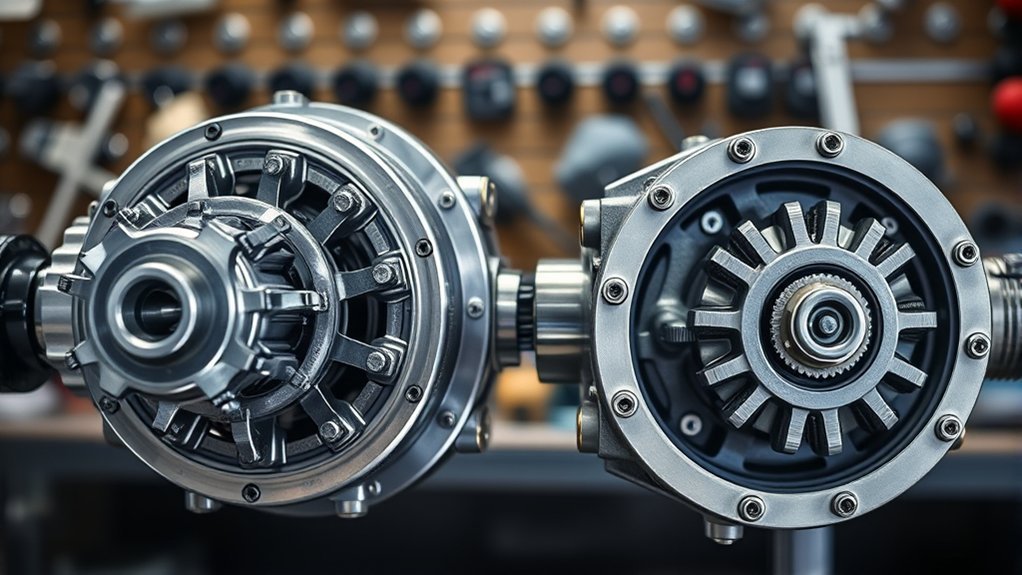
When deciding between limited slip differentials (LSD) and open differentials, you’ll find key differences in performance and traction. Open differentials allow wheels to rotate at different speeds, but struggle with traction loss on slippery surfaces. LSDs distribute power to the wheel with grip, enhancing stability during turns and improving handling in challenging conditions. This makes LSDs ideal for performance, off-road, and towing situations. Explore how each type can influence your vehicle’s capabilities further.
What Are Differentials and Why Do They Matter?
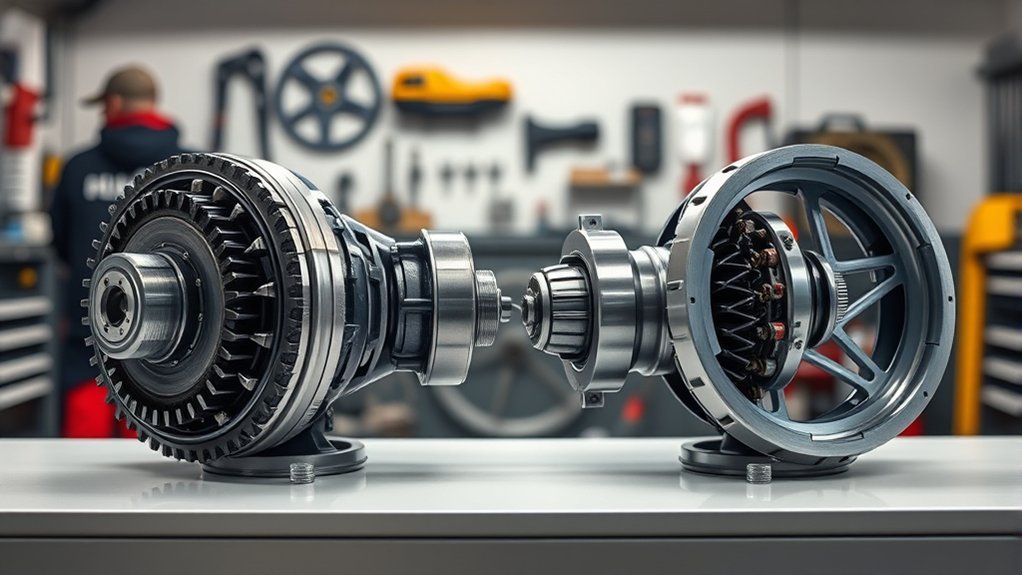
Differentials play an essential role in vehicle dynamics, enabling the wheels to rotate at different speeds during turns. Understanding the types of differentials, particularly open and limited slip differentials, is vital for optimizing your vehicle’s performance. An open differential distributes equal power to both wheels but can struggle with traction on slippery surfaces, leading to reduced vehicle handling. This limitation can be problematic, especially in adverse conditions where one wheel may lose grip.
In contrast, a limited slip differential (LSD) enhances traction by redistributing power to the wheel with better grip, providing superior stability and control. As a result, LSDs are particularly beneficial for aggressive driving or traversing uneven terrain. By knowing the impact of these differentials on vehicle handling, you can make informed decisions tailored to your specific driving needs, ensuring you maximize both performance and safety on the road.
How Open Differentials Work: Benefits and Limitations
Open differentials operate by allowing the left and right wheels to rotate at varying speeds, which is vital for smooth handling during turns. This design is prevalent in over 90% of street vehicles, making them suitable for everyday driving due to their reliability and simplicity. However, one significant limitation arises when traction loss occurs, particularly on slippery surfaces. In such cases, the open differential can send power to the wheel with less grip, causing the inside wheel to spin while the outside wheel maintains traction. This results in a loss of power and control, complicating acceleration. Furthermore, open differentials fall short in performance driving situations, like drifting, where consistent power to both wheels is essential for maintaining control. While they serve well in typical driving conditions, understanding their limitations is key for any driver seeking ideal performance and safety on the road.
How Limited Slip Differentials Boost Your Ride
When you encounter slippery or uneven surfaces, a Limited Slip Differential (LSD) can be a game changer for your vehicle’s performance. This technology drastically enhances traction by effectively transferring power to the wheel with better grip, unlike an open differential that allows one wheel to spin freely. Here’s how LSD boosts your ride:
A Limited Slip Differential enhances traction and performance, ensuring power reaches the wheel with grip on slippery surfaces.
- Improved Traction: It locks the differential when needed, ensuring power reaches the wheel with traction.
- Enhanced Handling: You’ll experience superior stability during turns, making every corner feel controlled.
- Reduced Stuck Chances: Say goodbye to getting stuck in mud, snow, or ice; LSD minimizes those frustrating moments.
- Better Acceleration: Enjoy increased confidence and control during acceleration, even in challenging conditions.
Incorporating a limited-slip differential into your vehicle transforms your driving experience, granting you the freedom to tackle any terrain with confidence and ease.
Comparing Open and Limited Slip Differentials: Key Differences
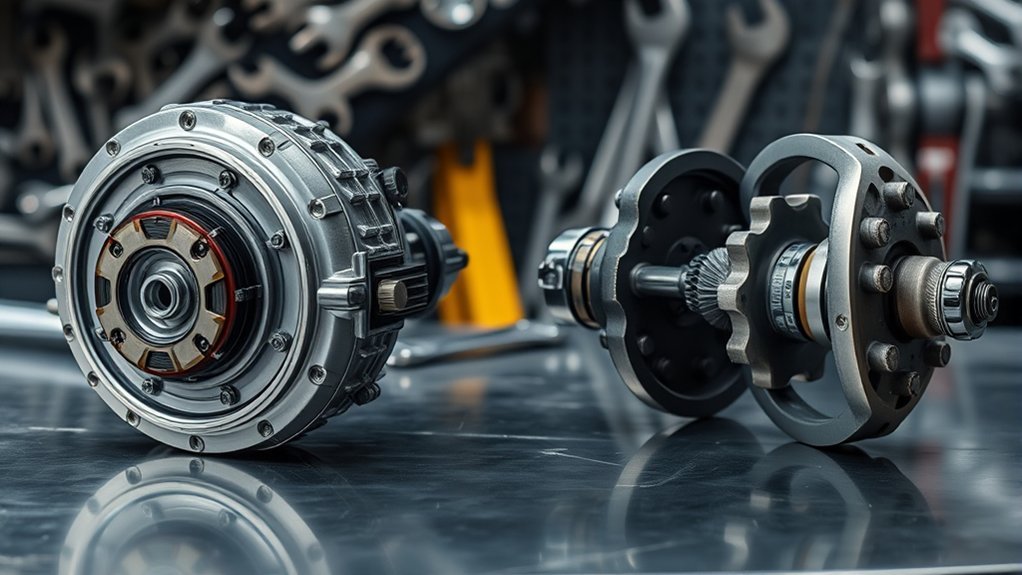
Understanding the differences between open and limited slip differentials can greatly impact your vehicle’s performance and handling. Open differentials allow the left and right wheels to rotate at different speeds, which is beneficial for smooth turning. However, they can lead to power loss when one wheel slips, compromising traction. In contrast, limited slip differentials (LSDs) enhance traction by distributing power to the wheel with more grip, considerably reducing the risk of getting stuck in low-traction conditions.
While open differentials dominate over 90% of street cars due to their simplicity, LSDs are preferred in performance and off-road vehicles because they provide improved stability and control. The design variations of LSDs, including clutch-based, cone-type, and helical gear, each offer unique advantages in performance. Ultimately, choosing between an open and limited slip differential hinges on your driving style and the conditions you encounter.
When to Choose a Limited Slip Differential: A Practical Guide
Choosing the right differential can greatly enhance your vehicle’s performance in specific driving conditions. If you’re considering a Limited Slip Differential (LSD), think about these scenarios:
Choosing the right differential can significantly improve your vehicle’s performance in various driving conditions.
- Slippery Conditions: You need better traction when driving on ice or wet roads.
- Off-Road Adventures: Tackling uneven terrains, an LSD improves handling and prevents getting stuck in mud or snow.
- Performance Driving: You crave better cornering capabilities, reducing tire slip for consistent power delivery during turns.
- Towing: If you often haul heavy loads, an LSD helps manage weight distribution, ensuring safer driving.
In contrast to an open differential, which can lead to wheel spin, a Limited Slip Differential locks the wheels together as needed, enhancing stability and control. By making this choice, you’re not just improving your vehicle; you’re liberating your driving experience.
Frequently Asked Questions
Which Is Better, Limited Slip or Open Differential?
For performance comparison, limited slip differentials excel in traction control, especially in challenging driving conditions, enhancing vehicle handling. However, consider cost analysis and maintenance requirements; open differentials might suffice for regular driving needs.
What Are the Downsides of Limited Slip Differentials?
Limited slip differentials can lead to increased wear, complex installation, higher costs, potential noise, heat generation, and limited performance. You’ll need to weigh these downsides against the traction benefits they offer in various driving conditions.
Why Would You Want an Open Diff?
You’d want an open diff for its cost effectiveness, maintenance simplicity, and lighter weight. It excels in vehicle applications requiring smooth traction response, making it ideal for everyday driving without the complexity of performance systems.
What Are the Disadvantages of Open Diffs?
Open diff limitations lead to traction issues, causing performance drawbacks in slippery conditions. You’ll face off-road challenges, excessive tire wear, and handling problems during turns, making it less suitable for demanding driving situations.
Conclusion
In conclusion, understanding the differences between open and limited slip differentials can greatly enhance your driving experience, much like knowing the right tool for a job. Open differentials offer simplicity and cost-effectiveness, but they can struggle in slippery conditions. Limited slip differentials, on the other hand, provide better traction and control, making them ideal for performance and off-road driving. Ultimately, your choice should align with your driving needs and the environments you’ll encounter.