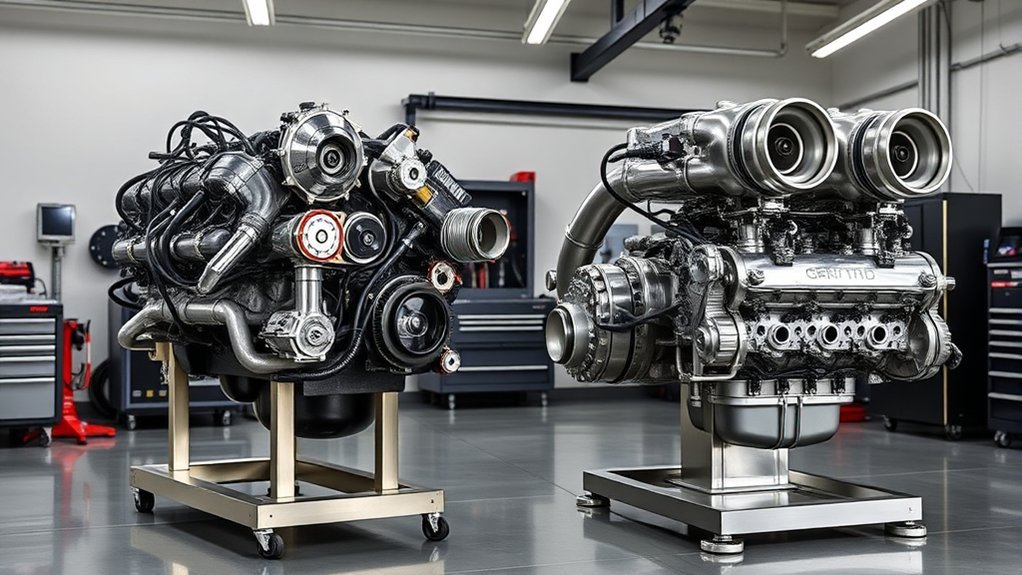
When comparing sequential and parallel turbo systems, you’ll notice distinct performance characteristics. Sequential turbos optimize power delivery with quick spool at low RPMs and enhanced performance at higher RPMs. In contrast, parallel turbos provide reliable power through simultaneous operation, simplifying maintenance. Both configurations have their benefits and trade-offs regarding installation complexity, performance goals, and engine responsiveness. Exploring deeper will reveal essential insights into choosing the best setup for your performance needs.
What Are Sequential and Parallel Turbo Systems?
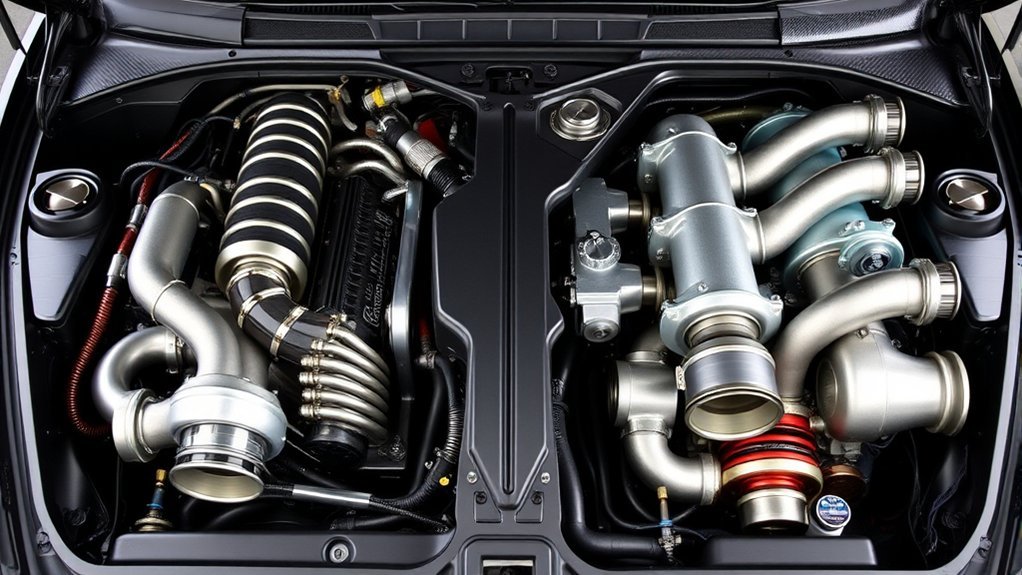
When comparing turbo systems, it is crucial to understand the fundamental differences between sequential and parallel configurations. A sequential setup employs two turbochargers: a smaller one kicks in at low RPMs to reduce turbo lag, while a larger one engages at higher RPMs for peak power. This configuration, though capable of offering rapid response, often requires intricate piping and sophisticated electronic controls, which can add complexity.
In contrast, a parallel setup utilizes identical turbochargers operating simultaneously. Each turbo manages exhaust gases from separate banks in V6 or V8 engines, ensuring consistent power delivery with simplicity and reliability. The first production sequential system appeared in the 1986 Porsche 959, while parallel twin-turbo systems gained fame with the 1981 Maserati Biturbo. Both setups have distinct trade-offs: sequential turbos excel in responsiveness, while parallel systems offer easier maintenance and straightforward operation.
How Do Sequential Turbo Systems Enhance Performance?
Sequential turbo systems greatly enhance performance by utilizing a two-turbo configuration that optimizes power delivery across various RPM ranges. In this setup, a smaller turbo quickly spools at low RPMs to minimize turbo lag, allowing for immediate boost response. As your engine reaches higher RPMs, a larger turbo takes over, ensuring you achieve higher boost levels without a significant drop in power.
A compression valve efficiently directs exhaust flow to the larger turbo when RPMs surpass a specific threshold, facilitating a seamless shift that maintains a linear power band. This design not only improves acceleration but also provides smoother power delivery, particularly advantageous in urban driving. First seen in the 1986 Porsche 959, sequential systems demonstrated remarkable improvements in responsiveness compared to traditional configurations. Overall, these systems can yield higher maximum power outputs, enhancing your driving experience across a broader range of engine speeds.
How Do Parallel Turbo Systems Work?
Parallel turbo systems utilize two identical turbochargers that operate simultaneously, each responsible for compressing exhaust gases from one bank of cylinders in V6 or V8 engines. This configuration enhances power delivery by allowing quicker response times due to reduced exhaust volume for each turbo. As both turbos engage together, you experience a more linear boost across the RPM range, which is particularly beneficial for performance applications.
Precise synchronization is critical in this system to guarantee balanced boost pressure, often achieved via a pressure equalization pipe. Additionally, parallel twin-turbo setups are generally simpler and more reliable than sequential systems, resulting in fewer mechanical failures and easier troubleshooting. The design also promotes better fuel efficiency and smoother emissions compliance, as boost engagement typically occurs at higher RPMs. Overall, parallel turbo systems deliver power and efficiency, catering to those who seek liberation in performance.
Top Benefits of Sequential Turbos
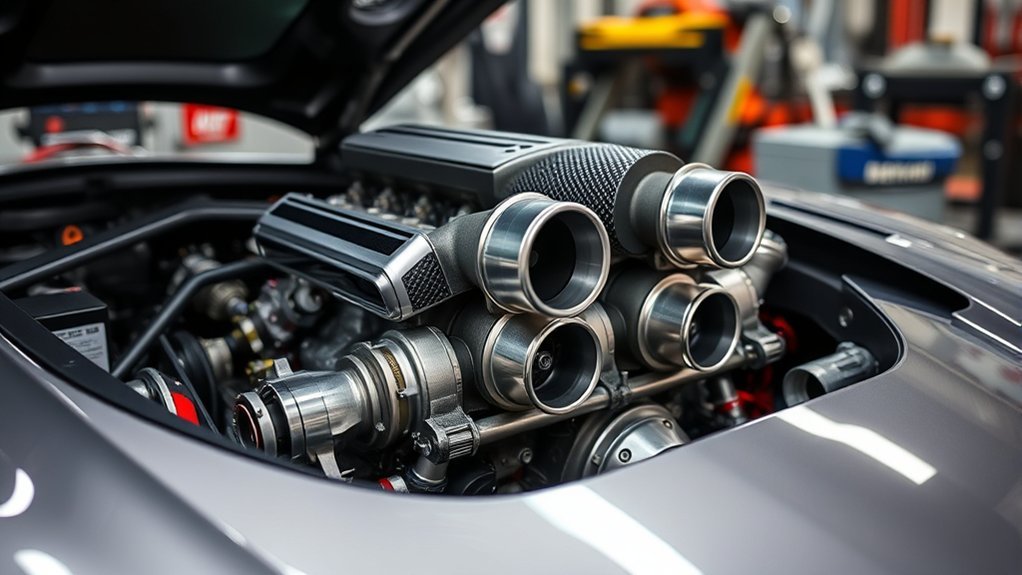
Turbocharging technology has evolved to meet diverse performance needs, with sequential turbos offering distinct advantages over their parallel counterparts. By utilizing a smaller turbo for low RPMs, you experience quick spool times that enhance acceleration and minimize lag. As you reach higher RPMs, a larger turbo engages, delivering superior boost pressure for high-speed performance. This responsiveness is particularly beneficial in urban settings where stop-and-go traffic demands rapid acceleration.
| Benefit | Description | Impact on Performance |
|---|---|---|
| Quick Spool Times | Immediate boost response | Enhanced acceleration at low RPMs |
| Reduced Turbo Lag | Smaller turbo for low to mid RPMs | Smoother power delivery |
| Efficient Exhaust Flow | Redistributes exhaust between two turbos | Improved overall engine efficiency |
| Proven Performance History | First used in Porsche 959 (1986) | Benchmark for high-output applications |
Sequential turbos empower your driving experience, providing a blend of efficiency and power.
Why Choose Parallel Turbos for Simplicity?
Choosing parallel turbos simplifies your setup by ensuring reliable power delivery with fewer components. This design allows for an easier installation process, as each turbocharger is dedicated to one bank of cylinders, reducing complexity. With quicker response times and stable boost pressure, parallel systems offer a straightforward approach to performance enhancement.
Reliable Power Delivery
When it comes to reliable power delivery, opting for parallel turbos simplifies the entire system. With a parallel twin-turbo setup, each turbo manages exhaust gases from its respective bank of cylinders, ensuring balanced power across the RPM range. This configuration reduces the number of components, minimizing potential mechanical failures and streamlining troubleshooting. Because smaller turbos respond faster to throttle inputs, you’ll notice immediate boost levels, particularly at lower RPM. Adding a pressure equalization pipe further stabilizes boost pressure between the turbos, enhancing your acceleration experience. For performance-oriented vehicles, the straightforward nature of parallel turbos makes them an ideal choice for achieving reliable and linear power delivery, allowing you to enjoy a liberated driving experience.
Easier Installation Process
While considering the installation process, parallel turbos offer a significant advantage in simplicity. Their design allows both turbos to operate simultaneously, streamlining the installation and reducing complexity. Here are key reasons why parallel setups are preferable:
- Fewer components, minimizing installation errors
- Quicker spool times for enhanced responsiveness
- Basic synchronization techniques for accessibility
- Easier troubleshooting and maintenance
- Reduced potential failure points compared to sequential systems
What Are the Trade-Offs of Each Turbo Configuration?
Understanding the trade-offs between sequential and parallel turbo configurations is essential for optimizing performance in specific driving scenarios. Sequential setups excel at minimizing turbo lag at low RPMs, utilizing a smaller turbo initially before engaging a larger one at higher RPMs. However, this complexity can lead to higher costs and maintenance needs due to intricate piping and electronic controls.
On the other hand, parallel twin-turbo systems provide simplicity and reliability, allowing simultaneous operation of two identical turbos. While they generally deliver a more linear power curve, they may suffer from slower spool times and uneven boost if not properly synchronized, which can result in noticeable lag during acceleration. Ultimately, your choice depends on whether you prioritize responsive performance at high RPMs or consistent efficiency, balancing the benefits against the potential drawbacks of maintenance and performance characteristics in your driving experience.
Installation and Maintenance of Sequential vs. Parallel Turbo Systems
When considering installation complexity, sequential turbo systems require intricate piping and electronic controls, which can lead to more maintenance challenges. In contrast, parallel turbo setups offer a more straightforward installation process, reducing the potential for common issues. Understanding these differences in installation and maintenance is essential for optimizing performance and reliability in your choice of turbo configuration.
Installation Complexity Comparison
Installing turbo systems can vary greatly in complexity, particularly when comparing sequential and parallel setups. You’ll find that sequential turbo systems introduce several installation challenges:
- Complex piping and additional components increase installation difficulty.
- Bypass valves and electronic controls require precise calibration.
- A higher likelihood of mechanical failures looms due to intricate systems.
- Maintenance challenges multiply with more frequent checks on added parts.
- Parallel turbo systems allow for straightforward installation and troubleshooting.
On the other hand, parallel turbo systems operate both turbos simultaneously, benefiting from a simpler design that minimizes risk. They provide a stable and synchronous operation without the need for intricate tuning, making them a more liberating choice for those seeking efficiency without excessive complexity.
Maintenance Requirements Overview
While both sequential and parallel turbo systems enhance engine performance, their maintenance requirements diverge markedly due to inherent design complexities. Sequential setups demand more intricate maintenance due to elaborate piping and electronic control components, raising the risk of mechanical failures. You’ll need to monitor vacuum hoses and solenoids closely, replacing them as necessary to guarantee peak performance. In contrast, parallel turbos involve fewer components, simplifying troubleshooting and reducing overall maintenance needs. Regular checks focus on maintaining equal boost pressure and synchronization, requiring less frequent intervention. Consequently, users of sequential systems often report a heightened need for ongoing upkeep and vigilance to manage turbo shifts and guarantee consistent boost levels, making careful maintenance essential to harnessing their full potential.
Common Installation Issues
Though sequential turbo systems can considerably enhance performance, they often come with installation challenges that can complicate the process. Here are some common issues you might encounter:
- Improper hose fittings leading to boost leaks
- Vacuum line failures causing performance drops
- Installation complexity increasing maintenance needs
- Difficulty in synchronizing boost pressure with parallel turbos
- Frequent repairs due to intricate electronic controls
These challenges can result in frustration and hinder the liberation you seek from your vehicle’s performance. While parallel turbos offer a more straightforward setup with fewer components, you must still guarantee balanced boost pressure. Understanding these installation issues can empower you to make informed decisions and enhance your driving experience.
Real-World Performance: Comparing Sequential and Parallel Turbo Systems
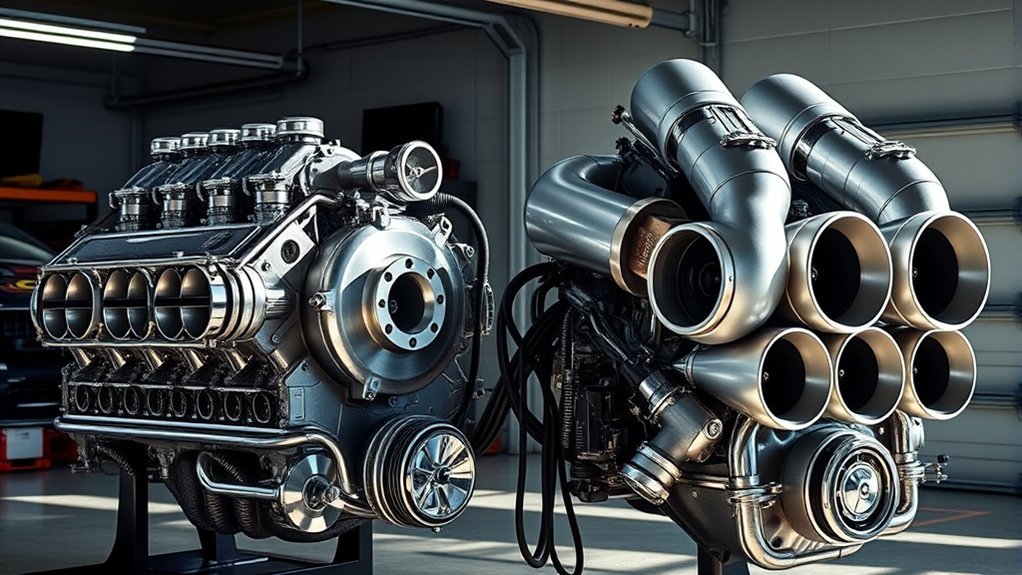
How do sequential and parallel turbo systems measure up in real-world performance? Sequential turbos excel by using a smaller turbo at low RPMs, allowing for minimal lag and smooth power delivery. As you accelerate into high RPMs, a larger turbo kicks in, enhancing responsiveness and performance, especially in urban driving where quick acceleration is essential. The Porsche 959 exemplifies this, achieving rapid spool times and impressive performance metrics.
On the other hand, parallel turbos, like those in the BMW N54, operate both turbos simultaneously. This design offers reliable power but may suffer from slower spool times, leading to noticeable lag compared to sequential setups. While you can count on consistent power gains, the seamless shift found in sequential systems is often superior. Overall, if you prioritize responsiveness and acceleration across the RPM range, the sequential turbo clearly stands out in real-world applications.
How to Choose Between Sequential and Parallel Turbo Systems?
When deciding between sequential and parallel turbo systems, what are the key factors you should consider? Understanding your performance needs will guide your choice effectively. Here are some critical points to ponder:
When choosing between sequential and parallel turbo systems, assess your performance needs to make an informed decision.
- Engine Speed: Do you need quick spool times at low RPMs?
- Simplicity: Is reliability and ease of maintenance a priority for you?
- Performance Goals: Are you focused on high-end power or consistent power delivery?
- Cost: Can your budget accommodate the complexity of a sequential turbo system?
- Fuel Efficiency: Do you want better emissions compliance and fuel economy?
If you value immediate boost response, a sequential turbo system may be your best bet. However, for consistent power across the RPM range with simpler upkeep, a parallel turbo system could be the ideal choice. Evaluate these aspects to liberate your engine’s full potential.
Frequently Asked Questions
What Are the Benefits of Sequential Turbos?
Sequential turbos enhance turbo efficiency, providing immediate boost response at low RPMs. This dual-turbo setup optimizes engine performance, ensuring smooth power delivery and maximizing acceleration, ultimately delivering a more responsive and exhilarating driving experience.
What Are Parallel Turbos Used For?
You’ll find parallel turbos primarily in V6 and V8 engines. Their advantages include quicker throttle response and minimized lag, though installation challenges may arise. They’re compatible with setups needing balanced power delivery and reliable performance comparison.
Is It Better to Have 2 Small Turbos or 1 Big Turbo?
It’s often better to choose two small turbos for improved turbo performance and engine efficiency. This configuration enhances boost response and power delivery, minimizing lag while providing a more engaging driving experience across various RPMs.
Is Sequential Turbo the Same as Twin-Turbo?
No, a sequential turbo isn’t the same as a twin-turbo. While both enhance performance, sequential turbo advantages lie in staggered operation, offering unique turbocharging technology benefits that a standard twin-turbo setup can’t match in efficiency.
Conclusion
To sum up, choosing between sequential and parallel turbo systems boils down to your specific performance needs. Did you know that vehicles equipped with sequential turbos can experience up to 20% more power at lower RPMs compared to their parallel counterparts? This statistic highlights the efficiency of sequential setups, especially in enhancing throttle response. Ultimately, evaluating your driving style and performance goals will guide you in making the right decision for your turbocharging needs.